Showing posts with label Cardinal. Show all posts

Wednesday, August 7, 2019

Wildlife Wednesday August 2019

Nature's camouflage is fascinating and August's Wildlife Wednesday is a good time to share a few examples I've observed recently in my garden.  Wildlife Wednesday is hosted by Tina at My gardener says..." on the first Wednesday of each month.

Close observation presents many surprising opportunities to enjoy tiny wildlife.  First up is a busy bee coated with pollen cleverly disguised in yellow blooms of Twisted rib cactus.


This brown moth on a Skeleton Leaf Golden Eye seed head blends right in.


On closer look it's mostly the movement which gives it away.


Red male cardinals have a bit of a challenge trying to hide but Mrs. C is harder to spot in the fig tree.


She's out in the open now fussing at me.


Not camouflage but a strange looking bird requiring a closer look.  This one took a minute to ID but then I remembered Tina's post from a while back showing a molting Cardinal.  That's what I think is happening here.


Birds breathe through their mouth and it's more obvious when it's hot out.  Between the heat and molting this poor guy has got to be very uncomfortable.


A common garden spider (Argiope aurantia) was reeling in her prey just as I walked by and before I could focus my camera.  Her web was so close to the ground I almost missed it.


I sat down beside her and neither of us were frightened away.   She carefully rolled up her bundle which was the size of a small bee while I watched.


Nearby in the garden bees are busy.


I think both of these are solitary bees.

 
An almost transparent cicada I nearly missed has freshly emerged from an outgrown, discarded shell to the right.


A slightly older cicada on Pomegranate 'Wonderful' branch.  It was the bird's nest wrapped in a recycled plastic bag which first caught my eye.  We live near a busy road and commercial center so there's usually a supply of plastic bags around which we try to keep picked up.  I've walked by this tree a number of times without seeing the nest tucked in there.  Observing the nest let me see the cicada as well.


Cicadas usually stick around for about four weeks after emerging from the ground.  They are noisy!  Those transparent wings are cool.


Tiny anole keeping to the shade on cool stone near the hose bib.  It was smooth-skinned and I also saw a green one so these are not likely invasive brown anoles.


It's too hot for a GIF this month.  I stationed myself in the shade for a while but GIFs take time to set up.  So we'll move on to the deer report.  It's time to protect plants from antlering.  All this velvet will soon be rubbed off on whatever is handy including young trees, agaves and many other unsuspecting plants you might have in the garden.


After the velvet is gone, he will stick to the woods where his antlers will be disguised as twigs.  Right now he's here for the water we leave outside the gate during hot dry weather so he's not as shy.


The same for these ladies which prefer to rest in dappled shade.  Scratches on her hide are hoof marks from mating.


That's the wildlife report from my garden the past month.  You'll find more wildlife posts in the comments at Tina's blog.  Try a wildlife post of your own if you're a blogger.  It's fun and I'm often surprised by how many wildlife photos I've collected when I sit down to create my post.

Wednesday, August 1, 2018

Wildlife Wednesday August 2018

The first Wednesday of the month is Wildlife Wednesday when Tina at My Gardener Says... provides an opportunity to share garden wildlife from July.  A few of these are from June since I missed posting the week of July 4th last month.

Again this year a Whitetail doe has chosen our corner as a base for raising her fawn.


Probably about one day old when it ran to the neighbor's door after being startled.


A snapping camera doesn't seem safe so it's out of there quickly.


Run, run, run


Oh, how sweet!


For just over a week they were likely to turn up whenever I went outside or even just looked out the window as in this photo.  She leaves her fawn for hours at a time to keep it safe but she's never far away and always on watch.  Fawns have no scent to attract predators and they can communicate from quite a distance with a series of sounds.  Deer are highly nomadic moving up and down the creek which runs through the neighborhood so we might not see them again for a few weeks.


A buzzard landing on the roof peak.  There's a small natural area full of typical wildlife like raccoons and possums along a busy road behind us which keeps the buzzards busy.


A Cardinal helping himself to ripe figs as viewed through the kitchen window.  It's always a contest because figs must be picked at the peak of ripeness.  Unripened figs are not tasty and do not improve with age.  We got a few figs this year in spite of the birds.


This month's GIF is a hummingbird on tiny lily-like flowers of an Agave stricta bloom.


I wasn't sure about keeping American Germander in my garden until I saw this Hummingbird enjoying the blooms.


So much work to do it needs a rest on the fence.


Cicadas are a dominant bug in the heat of summer.


I've not really thought of them as pretty but clear wings are interesting.  They chew a hole in soft plant tissue to lay eggs but I don't think this Agave sisalana is the place which is why it moved on quickly.


I noticed this Leaf-Footed bug on the rusty gate while out with my camera.


It wasn't until I downloaded the photo I saw the casing to the right.  I think this might be a newly molted bug leaving its old shell behind.


Bees love this Passiflora Foetida we rescued from an undeveloped commercial property nearby.  The process of collecting cuttings and seeds to get it established took nearly eight years.  Now that the vine has returned three years in a row I think we can say it's found a home here.  We've even successfully transplanted seedlings to other parts of the yard.


Not native but still popular with butterflies is Pride of Barbados which blooms in the hottest part of summer.


Same Swallowtail, different light seconds later.


Wings open reveal bright blue indicating a female Spicebush Swallowtail.


Queen Butterfly defies the heat to enjoy a native Kidneywood tree in dappled sun.  Queen butterflies are here most of the year.


Gulf Fritillaries are here almost as often throughout the year.


After a July thunderstorm the air above the garden filled with flying insects best seen against the shed as a backdrop.  There were hundreds of them.  Flying ants!  I got close to see for sure and just made out the shape of ants against the gray sky.  Mature ants leaving the colony to start a new one is called a nuptial flight.  Only reproductive males and queens do this when they are ready to mate.  The queens are the specks you can see and the males are less visible.  We haven't seen many new ant mounds yet.


Toads emerging immediately after a rain continues to be a mystery to me.  We have little rain in the summer and few sources of water for them.  I even looked it up and they take 7-10 days to hatch.  It's about the size of a thumbnail.  Baby toads and cactus, which of these doesn't belong.  Smart toads find a spot near the hose bib where life is good.


That's the roundup of wildlife in my garden for the last month or so be sure to visit Tina to see the wonderful wildlife her garden attracts and to check out the comments section for more garden wildlife.

Wednesday, February 7, 2018

Wildlife Wednesday: February 2018

It's the first Wednesday of February and that means Wildlife Wednesday hosted by Tina at "My Gardener Says....".  It's still cold down here in South Texas on most days so wildlife sightings are not as easy. But I did observe a few interesting things this month.

One bright spot in winter are the Cardinals which visit our feeder almost daily.  The best squirrel-proof feeder we've found is this small basket suspended on flexible electrical cable.  The original top degraded in the sun and we replaced it with a plastic bowl from the thrift store.  The feeder is too slippery for squirrels and also keeps out larger birds like Pigeons and Jays.


They often appear in pairs taking turns at the feeder and are quite thoughtful of each other.


Speaking of squirrels.  What we have here is a stand off....


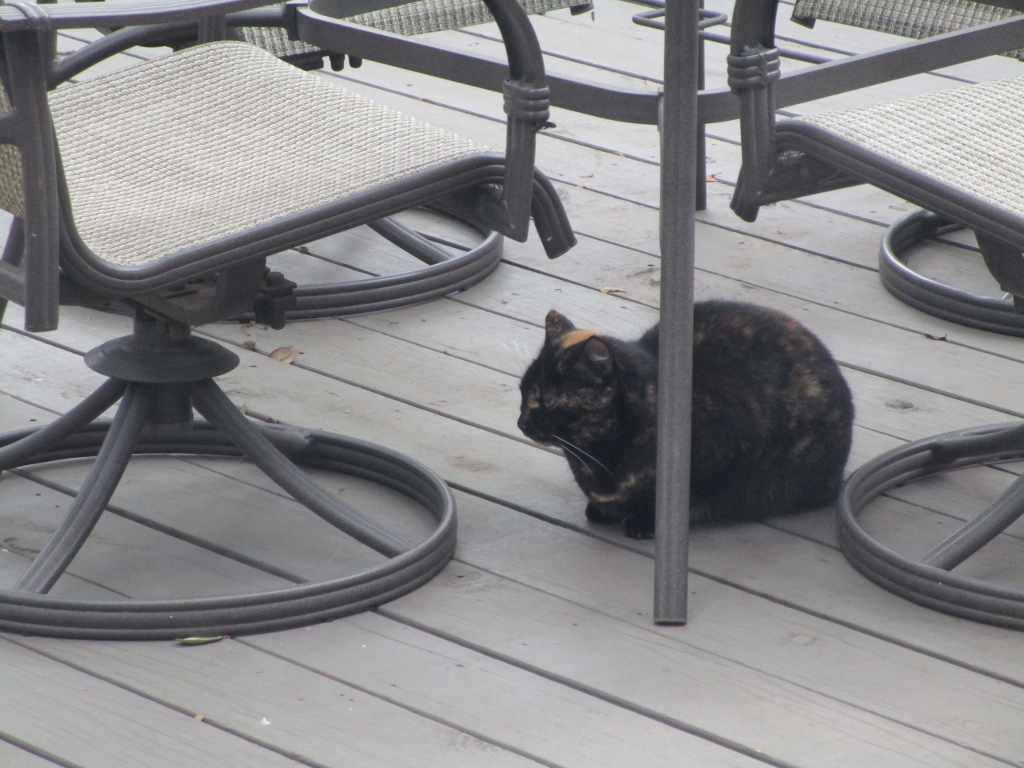
...with the cat.  She arrived as a feral cat and has tamed down quite well though she is still an outdoor cat.  We have also made sure she cannot reach the feeder so it all works.


We have both foxes and coyotes in the neighborhood.  Last month I showed you a coyote walking through the yard in daylight.  Below is a fox on the deck.  She's not happy there's no food in the cat bowl and leaves a mark in disgust.  I originally labeled this as a coyote but Anna pointed out it is a fox.  They are similar but the fox is smaller with shorter snout and more fur.


We now place a gate across the steps to help keep coyotes away from the house.

The deer herd has migrated back to our end of the creek and we should be seeing new fawns soon.  Not much to eat with such dry plants out there.  They don't eat the prickly ash juniper which is the only green in the background.  While several of our neighbors feed the deer, we have chosen not to with the exception of water in the heat of summer.


She's still not happy about being fenced out of the garden.

Check out the comments section at "My Gardener Says..." for more blogger backyard wildlife.

Wednesday, July 6, 2016

Wildlife Wednesday: July 2016

Wildlife Wednesday celebrates its two-year anniversary today.  Two years of taking time on the first Wednesday of each month to post about wildlife in my garden and linking up with our hostess Tina at "My Gardener says...." for a look at wildlife in blogger gardens far and wide.  I appreciate the nudge this meme gives me to keep a camera handy and an eye out for wildlife while in the garden.

Almost every month I come up with a .GIF or "Awesome Motion" in Google terms.  For July it's an Anole up in a live oak showing off his dewlap to assert his territory and attract a mate.


Wednesday, September 2, 2015

Wildlife Wednesday September 2015: Barred Owl update and other antics

It's the first Wednesday of September and I'm joining Tina at My Gardener Says... for a look at the wildlife in my yard.  Last month for Wildlife Wednesday I featured our frequent guest the Barred Owl which was surprisingly active in the daytime.

We've seen him a few more times.


Tuesday, February 7, 2012

Plant ABC's - C is for Callicarpa Americana

The "ABC's of plants in my garden" series continues with Callicarpa americana which is commonly known as American Beautyberry.  That's certainly a good descriptive name for this native plant.


The bright purple berries are strikingly beautiful.  When it's blooming the  neighbors stop to ask about it.  In summer the leafy open pattern provides shade for part-sun plants.  They grow best under larger trees and are a lovely welcome along the walk to the shadier part of the garden.  These are 15 years old and are about six feet tall now with a few trims over the years.  They are very drought tolerant, although in last year's extreme drought they didn't look as good as in the past.


The berries form in late summer along the arching branches.  The photo below was taken before I began blogging so it isn't the best, but you can just see the berry laden branches in the center near the walk.


Callicarpa americana is deciduous and the branches are quite bare after the birds and deer have stripped all the berries so they work best against an evergreen background.


Just in case you think we forgot to rake the leaves, the leaves in this area intentionally remain where they fall as a natural plant mulch.

As soon as the berries begin to form, the birds, especially Cardinals and Mockingbirds, gather in the nearby shrubs and wait.  They test the the berries each day and devour the ripe ones until they are all gone.  The berries are safe for humans as well and are used to make jellies.  Herb tea is made from the root and the leaves are said to ward off mosquitoes and flies.


Beautyberry indeed.